
Fractional CISO: What the Role Covers and When It Fits
What a fractional CISO does, how the role differs from a full-time CISO, where it stops, and how to scope an engagement for a small or public-sector organization.
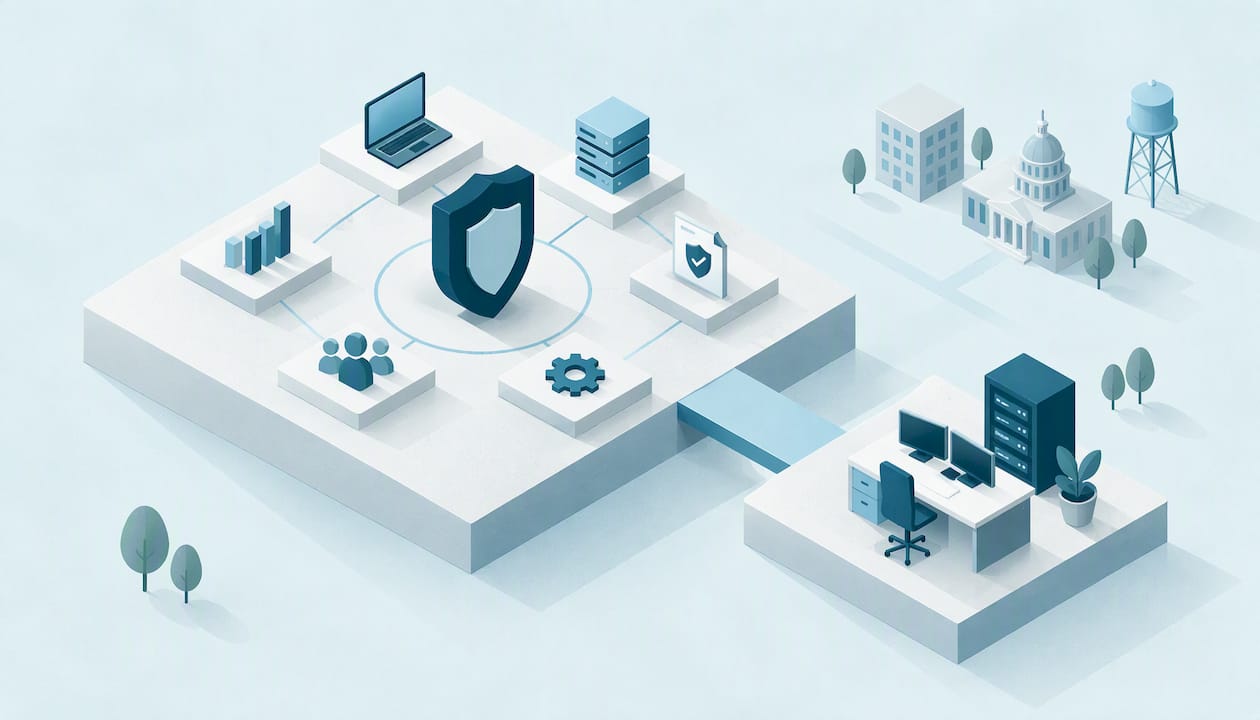
A fractional CISO is an experienced security executive who leads an organization's information security program on a part-time or retainer basis. The person owns strategy, risk decisions, policy, compliance direction and executive reporting, without the cost and hiring timeline of a full-time chief information security officer. It is a leadership role, not a monitoring service, and that distinction determines whether an engagement succeeds. This guide explains what the role includes, where it ends, how it compares with a full-time hire, and how small organizations and public-sector bodies should scope it.
TL;DR
- A fractional CISO (also called a virtual CISO) provides security leadership as a service: strategy, risk management, governance, third-party risk and audit coordination.
- ISACA describes the value of the role as executive communication, strategy and coordination, not as a substitute for every hands-on security practitioner.
- The role does not replace 24/7 detection and response. Someone still has to watch telemetry, triage alerts and contain incidents.
- The engagement works when responsibilities are defined in writing, leadership backs the role, an internal owner is named and documentation is transferable.
- Simvay's fractional CISO service is delivered by its in-house, US-based team, and pricing is scoped to the environment rather than published.
Table of Contents
- What a fractional CISO is
- What a fractional CISO does day to day
- Fractional, virtual, interim and full-time: how they differ
- When a fractional CISO makes sense
- What a fractional CISO does not do
- How to make the engagement work
- What affects fractional CISO cost
- Questions to ask a provider before signing
- Where Simvay fits
- FAQ
- Sources
What a fractional CISO is
The title borrows from the fractional executive model: a senior practitioner works for an organization for a defined share of their time. In security, the arrangement is also sold as virtual CISO or CISO-as-a-Service. ISACA's journal describes a virtual CISO as an independent security expert who typically works remotely and part time, often for several clients, and whose role generally covers security strategy, advice, coordination and management rather than hands-on firewall implementation.
That last clause matters. A fractional CISO is accountable for the shape of the security program: what the organization protects, which risks it accepts, which controls it funds and in what order. The engineers who configure those controls and the analysts who monitor them are a different function.
ISACA also notes that virtual and internal CISOs generally share similar qualifications, experience, roles and responsibilities. The difference is that the virtual CISO has to understand each client's business and market environment quickly and adapt the security strategy to it.
What a fractional CISO does day to day
Responsibilities vary by organization, but ISACA's guidance on the role lists information-security planning and management, organizational structure, security-risk management, third-party risk evaluation and coordination of audits by regulators or customers. In practice that translates into recurring work products:
- Risk assessment and a ranked remediation roadmap. An inventory of critical systems and data, the threats against them, and a sequence of fixes tied to budget and operational reality.
- Policy and standards. Acceptable use, access control, vendor management, backup and recovery, and incident response policies written so that staff can follow them and auditors can test them.
- Framework alignment. Mapping the program to the framework a regulator, insurer or customer expects, such as the NIST Cybersecurity Framework, and tracking gaps against it.
- Third-party risk. Reviewing the vendors that hold your data or connect to your network, and setting minimum security requirements in contracts.
- Executive and board reporting. Translating technical exposure into decisions leadership can make: fund this, accept that, defer the other.
- Incident readiness. Owning the incident response plan, running tabletop exercises and defining who decides what when an event is declared.
- Audit and assessment coordination. Serving as the single point of contact for auditors, cyber insurers and customer security questionnaires.
None of these is a tool deployment. Each is a decision-making or governance function, which is why the role is valuable to organizations that own tools but lack someone accountable for how they fit together.
Fractional, virtual, interim and full-time: how they differ
The terms overlap, and vendors use them loosely. A workable distinction:
| Model | Time commitment | Typical use | Main limitation |
|---|---|---|---|
| Full-time CISO | Dedicated, on staff | Large or heavily regulated organizations with a mature security team | Cost and hiring time; the seat can remain empty for months |
| Fractional or virtual CISO | Recurring, part-time share of a senior leader | Organizations that need accountable leadership without a full-time executive | Advisory by nature; capacity is shared |
| Interim CISO | Full-time for a limited period | Covering a vacancy or a transition | Temporary; needs a successor plan |
| Project-based security advisor | Defined deliverable | A single assessment, policy set or audit preparation | No continuing ownership of the program |
The fractional model sits between a project advisor and an executive hire. It gives continuity, because the same person tracks the roadmap quarter after quarter, without requiring the organization to build a full department around the seat.
When a fractional CISO makes sense
ISACA's guidance says small organizations handling sensitive information, resource-constrained organizations, and organizations that need specialized skills or a defined subset of a security program may benefit from a virtual CISO. Several recognizable situations fit that description.
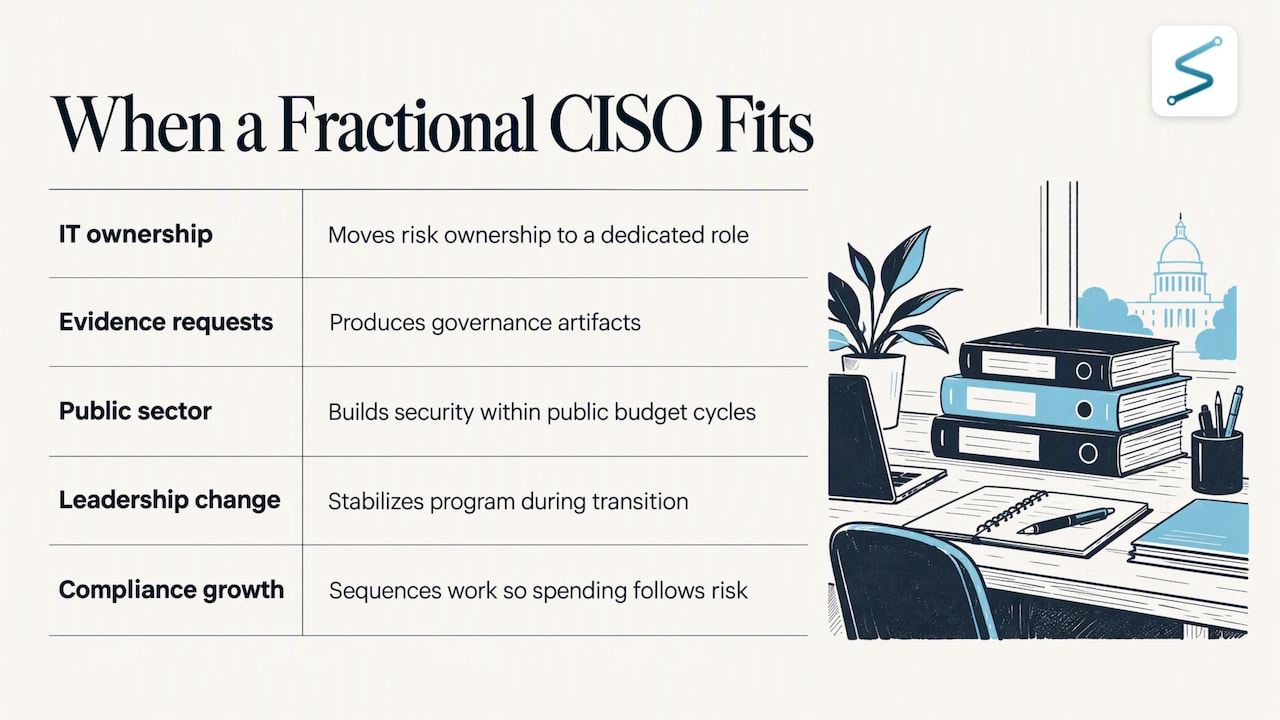
An IT generalist is carrying security by default. In many small and mid-sized organizations, an IT director or a single administrator also owns firewalls, identity, backups and the security questionnaire from the largest customer. Security decisions get made by whoever is closest to the problem. A fractional CISO moves risk ownership to a role built for it.
A customer, insurer or regulator is asking for evidence. Questionnaires, cyber insurance renewals and sector compliance requirements all ask who is responsible for security and what the program looks like on paper. A fractional CISO can produce the governance artifacts and stand behind them.
A public body needs dependable security without a new executive line. Local governments, public safety agencies and utilities often have security obligations that exceed their budget for a senior hire. Ohio's public-sector cybersecurity obligations, stated in general terms, expect political subdivisions to have defined security practices and to be able to respond to incidents. A fractional leader can build and maintain that program, including the policy, exercise and reporting layer, within a public budget cycle. Simvay's Who We Serve page describes the public-sector and critical-infrastructure work.
Leadership has changed. After the departure of a security lead, or an incident that exposed unclear ownership, a fractional engagement can stabilize the program while the organization decides on a permanent structure.
The organization is growing into compliance. Passing from an informal posture to one that must satisfy a framework or a contract clause is a leadership problem before it is a tooling problem. A fractional CISO sequences the work so spending follows risk.
Sectors vary, from K-12 districts to manufacturers to regional financial institutions, but the underlying condition is the same: real exposure, no dedicated security executive.
What a fractional CISO does not do
The most common failure in these engagements is a mismatch between expectation and scope. Three limits deserve to be stated plainly.
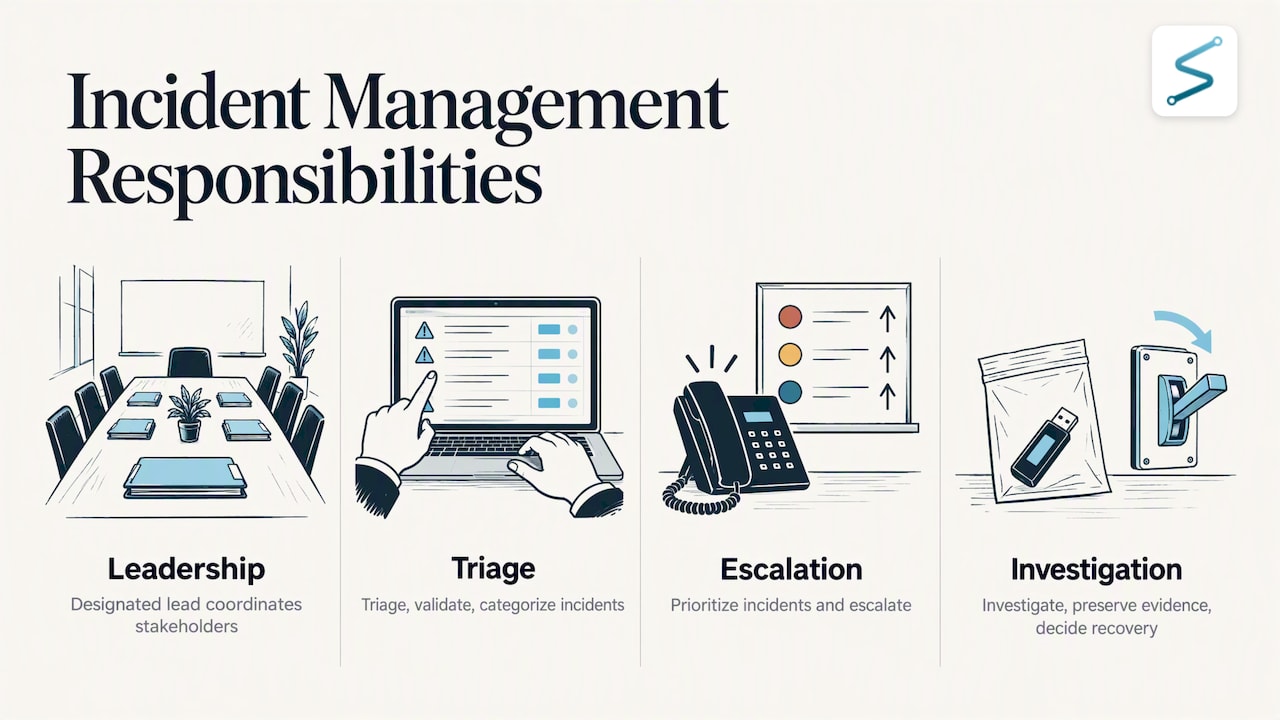
It is not 24/7 monitoring. A fractional CISO sets how detection and response should work, but does not sit in front of alerts overnight. Incident response includes designated incident leadership, triage and validation, categorization and prioritization, escalation, coordination with internal and external stakeholders, investigation, evidence preservation and recovery decisions. A part-time executive can own the plan and lead during a declared incident, but triage and containment at 3 a.m. need an operational team. Simvay's MDR and managed SIEM service covers continuous monitoring and response, and its incident response service covers retainers, tabletop exercises and playbook development.
It is not implementation labor. The role directs the roadmap. Patching, identity hardening, network changes and backup engineering are executed by administrators and engineers, whether internal or contracted. A roadmap with no one assigned to execute it is a document, not a program.
It is not guaranteed availability. ISACA's blog raises the question of whether a part-time virtual CISO serving multiple organizations can provide leadership and respond quickly. The question is a fair one to put to any provider: who answers during an incident, how fast, and what happens if the named leader is unavailable.
How to make the engagement work
ISACA cautions that because a virtual CISO is often temporary and primarily advisory, organizations should define responsibilities, secure executive and board buy-in, maintain clear communication and appoint an internal security-management champion. The same guidance says organizations should require adequate transition documentation. Turned into an operating checklist:
- Write the scope as decisions, not hours. List which decisions the fractional CISO owns (risk acceptance recommendations, policy approval, vendor security requirements, incident command during a declared event) and which stay with your executives.
- Name an internal champion. One employee with authority, typically the IT director or operations lead, receives the roadmap, tracks progress and carries continuity between sessions.
- Secure the sponsor. The CEO, city manager, superintendent or board needs to receive the reporting and act on it. A fractional CISO whose recommendations stop at IT will not change the risk profile.
- Set a cadence and outputs. Monthly or quarterly reporting against a ranked roadmap, with each item showing an owner, a due date and a status.
- Require transferable documentation. Policies, risk registers, asset inventories, exercise results and vendor reviews should live in systems you control, so a change of provider does not reset the program.
- Decide in advance how incidents are handled. Confirm who monitors, who declares, who communicates and who has authority to isolate systems.
Communication planning belongs in that last step. Security events become reputational events quickly, and leaders who have rehearsed their public response handle them better; this guide to managing reputation risk during a crisis is a reasonable companion to a tabletop exercise, because a part-time security leader will rarely be the person speaking to the press or the public.
What affects fractional CISO cost
Published figures for fractional CISO retainers come mostly from provider marketing and comparison pages, and none of them is a reliable benchmark for your organization, so this article gives no dollar range. Simvay does not publish a price for its fractional CISO service either; it is scoped to the environment. What matters more than a headline number is the set of factors that move any quote:
- Scope of decisions. Program leadership with board reporting is a different engagement from a single policy refresh.
- Cadence. Weekly working sessions cost more than a quarterly review.
- Compliance load. Meeting a sector framework, a customer contract or an insurer's requirements adds evidence collection and audit coordination.
- Size and complexity of the environment. Number of sites, systems, cloud tenants and third-party connections.
- Incident readiness. Whether tabletop exercises, playbook development or a response retainer are included or bought separately.
- Whether operations are bundled. Pairing leadership with monitoring and response under one team changes how work is split and priced. Simvay's own breakdown of what managed detection and response costs explains the operational side of that decision.
When you compare quotes, compare deliverables and responsibilities line by line. A lower monthly figure that excludes audit support, reporting or incident leadership is a smaller scope, not a better price.
Questions to ask a provider before signing
The quality of a fractional CISO engagement depends on specifics a sales page rarely states. Ask:
- Who exactly will lead the engagement, and will the same person be present for the full term?
- How many organizations does that person serve at once, and what is the response expectation during an incident?
- Who executes the roadmap? If the provider also offers operations, how are leadership and execution kept accountable to each other?
- Is any work outsourced or triaged offshore? For public-sector and critical-infrastructure organizations, the location and employment status of the people with access to your environment is a legitimate procurement question.
- What documentation do you keep after the term ends? Ask for samples of a risk register and a roadmap.
- How does the provider handle conflicts between security recommendations and operational priorities?
Where Simvay fits
Simvay is a Cleveland-rooted cybersecurity firm headquartered in Westlake, Ohio, serving Ohio and clients nationwide. It works with the small and mid-sized organizations that enterprise security firms tend to overlook, and with the public sector and critical infrastructure. Its fractional CISO service provides security leadership, with compliance programs available alongside it. Because Simvay's in-house, US-based team also runs security operations, the leadership that governs the program and the people who monitor and respond sit within one accountable team. Infrastructure support is delivered alongside a security engagement rather than as a standalone IT service. To see the full range, visit the Simvay services overview or review the compliance programs it structures to sector-specific frameworks.
FAQ
What is a fractional CISO?
A fractional CISO is an experienced security executive who leads an organization's security program on a part-time or retainer basis. According to ISACA, the role is typically remote and often shared across several clients, and it centers on strategy, advice, coordination and management. It is the same function as a virtual CISO or CISO-as-a-Service.
Is a fractional CISO the same as a virtual CISO?
In practice, yes. Both terms describe security leadership delivered part time by an outside expert. Some providers use "interim" for a full-time stand-in during a vacancy, so check whether a proposal describes a recurring share of time or a temporary full-time placement.
Does a fractional CISO provide 24/7 monitoring?
No. The role governs the program and owns planning, risk decisions and reporting, but around-the-clock detection and response requires an operational team. Many organizations pair fractional leadership with managed detection and response so that governance and operations stay aligned.
Who needs a fractional CISO?
Organizations with real security exposure and no dedicated security executive, including small organizations handling sensitive information and resource-constrained teams, according to ISACA's guidance. Local governments, public safety agencies and mid-sized businesses facing customer or insurer requirements commonly fall into that group.
What should I require from a fractional CISO engagement?
Define responsibilities in writing, secure sponsorship from executive leadership or the board, appoint an internal champion and require transition documentation, as ISACA recommends. Also confirm who responds during an incident and how quickly.
Sources
- ISACA Journal 2021, Volume 5: Virtual CISOs, Security Leader or Security Risk
- ISACA Journal 2022, Volume 2: HelpSource
- ISACA Now Blog 2021: When Are Virtual Chief Information Security Officers the Right Choice